The Echo-State Property Beyond ρ = 1: Empirical Forgetting Survives to ρ = 1.60 in a Saturating Reservoir
download whitepaper (pdf)
- registered 2026-08-12
- internal run log #34, #35
- 2 seeds × 9 ρ values, zero reversals
- replicated before publication
- promoted 2026-08-12
Abstract
This study originated in an open-ended design brief. The one spectral parameter every reservoir in this program treats as load-bearing is the recurrent matrix's spectral radius ρ, which classical echo-state theory [1] keeps below 1. With a saturating tanh the state is bounded regardless of ρ, so the behavior past that boundary is a checkable question: we swept the reference sparse-tanh reservoir, otherwise completely unchanged, across ρ ∈ 0.50–2.00 (nine points, two seeds, the second hardware-drawn), adding an empirical forgetting test — fork a washed-in reservoir against a randomly reset copy, feed both identical text, and measure whether they converge. Three replicated findings. (1) Full forgetting survives to ρ=1.60 — disagreement decays to exactly zero, 60–80% past the classical boundary — then breaks sharply between ρ=1.60 and 1.80 (final-disagreement ratio 0.000 → 0.45–0.46), the same narrow window in both seeds. (2) Ridge validation bits per character (bpc) degrades smoothly and monotonically from ρ=0.80 onward with no kink at either the classical or the empirical boundary, while decode depth keeps improving to an interior peak at exactly ρ=1.60 in both seeds — two separate mechanisms, and a further instance of the decodability–usability dissociation recorded elsewhere in this program. (3) Unplanned but registered as a named alternative in advance: ρ=0.50 and ρ=0.80 beat the program's own fixed-ρ=0.95 anchor (3.1472) at both seeds, by 0.0676/0.0670 bits at ρ=0.50 — the margins agree across seeds to 0.0006 bits. The standard baseline convention is not this architecture's own best setting; what, if anything, to change across the program is explicitly left open.
Keywords reservoir computing · echo state property · spectral radius · stability boundary · decodability–usability dissociation · pre-registration
§1 Introduction
The echo state property — the reservoir's state becoming a function of input history alone, independent of initial conditions — is classically guaranteed by keeping the spectral radius of the recurrent matrix below 1, and that sufficient condition has hardened, in practice, into a boundary that is rarely crossed [1][2]. For a linear reservoir, crossing it genuinely diverges. For a saturating tanh reservoir the state is confined to [−1,1]N by construction, so the interesting questions survive the crossing: does the forgetting property actually fail at ρ=1? Where does it really fail? And what happens to prediction and memory on the way?
§2 Method
The reference sparse-tanh reservoir (N=1024, fan-in-10 sparse random W, leak 1.0, bias 0.2, random input map — wiring identical to the archived reference reservoir of the addressed-memory ESN study) with one parameter unlocked: ρ ∈ {0.50, 0.80, 0.95, 1.00, 1.10, 1.30, 1.60, 1.80, 2.00}. Standard text8 splits [3], 2M training characters; ridge and logistic validation bits per character (bpc) and U3 decode depth (a linear decode-depth probe, in the program's internal instrument numbering) on the identical code path as every other reservoir. One new diagnostic, making the classical claim empirical:
# empirical echo-state test, per rho:
# wash 200 steps of real text into the reservoir, then FORK:
#   copy A keeps the washed-in state
#   copy B is hard-reset to uniform-random in [-1,1]^N
# feed both the IDENTICAL next 8000 characters; measure RMS
# per-unit disagreement at 0/10/50/200/1000/8000 steps.
conv_ratio = disagreement(8000) / disagreement(0)
# 0   => full forgetting (ESP holds in practice)
# >0  => a permanent memory of an arbitrary initial state
The replication seed (1726372129) was drawn from a hardware random-number generator with the raw draw recorded in the registration before running.
§3 Pre-registered predictions
A pilot run over the full grid was disclosed first; predictions were finalized after it and labeled pilot-informed:
- RC1 (headline): conv_ratio ≤ 0.05 for every ρ ≤ 1.60 and ≥ 0.3 at ρ ∈ {1.80, 2.00} — a sharp, localized transition strictly between 1.60 and 1.80. Named loss: the window sits anywhere else.
- RC2: ridge validation bpc monotonically non-decreasing across every adjacent pair from ρ=0.80 through 2.00 — no special kink at the classical ρ=1 line.
- RC3 (a predicted dissociation): decode depth has a strictly interior maximum while bpc has none over the same range — depth and bpc moving in opposite directions.
- RC4 (reproduction check): the sweep's own ρ=0.95 cell must reproduce the on-disk reference-reservoir anchor (3.1472) within 0.02 bits. Named alternative, rated a major surprise in advance: any cell beats the anchor outright.
- RCQ1/RCQ2 (bands): conv_ratio at ρ=2.00 stays ≥ 0.5; the best cell lands within 0.10 bits of the anchor.
The replication re-registered all of the above (RRC1–RRC4, both bands) for the fresh seed, with promotion pre-committed to RRC1 and RRC3 being confirmed cleanly, plus replication of RRC4's finding that cells beat the reference-reservoir anchor.
§4 Results
| ρ | ridge val bpc | U3 depth | conv_ratio |
|---|---|---|---|
| 0.50 | 3.0796 / 3.0802 | 7.18 / 7.18 | 0.000 / 0.000 |
| 0.80 | 3.1073 / 3.1155 | 9.16 / 9.25 | 0.000 / 0.000 |
| 0.95 | 3.1472 / 3.1566 | 10.11 / 10.17 | 0.000 / 0.000 |
| 1.00 | 3.1649 / 3.1742 | 10.30 / 10.36 | 0.000 / 0.000 |
| 1.10 | 3.2064 / 3.2155 | 10.63 / 10.72 | 0.000 / 0.000 |
| 1.30 | 3.3084 / 3.3180 | 11.33 / 11.50 | 0.000 / 0.000 |
| 1.60 | 3.4678 / 3.4766 | 12.10 / 12.35 | 0.000 / 0.000 |
| 1.80 | 3.5482 / 3.5554 | 12.03 / 12.21 | 0.462 / 0.447 |
| 2.00 | 3.6045 / 3.6103 | 11.63 / 11.72 | 0.724 / 0.634 |
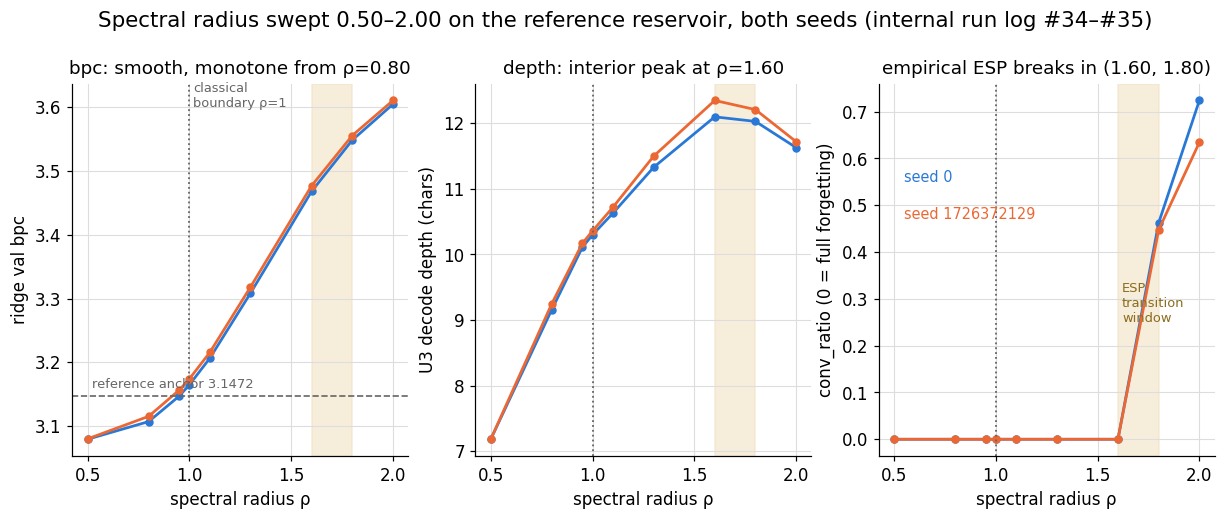
The empirical forgetting boundary is sharp, and lies well beyond the classical line. Disagreement between the forked copies decays to exactly zero at every ρ through 1.60, in both seeds — the reservoir state is a function of its input history alone even 60% past the classical boundary. At ρ=1.80 the two copies never converge (conv_ratio 0.462 / 0.447), and at ρ=2.00 the plateau deepens (0.724 / 0.634). The transition falls in the same narrow window in both seeds (RC1/RRC1 confirmed; RCQ1/RRCQ1 confirmed).
Prediction and memory dissociate across the same sweep. Ridge bpc worsens monotonically from ρ=0.80 through 2.00 — 7/7 adjacent pairs, both seeds, with no visible kink at either ρ=1 or the empirical transition — while decode depth keeps improving to an interior peak at exactly ρ=1.60 in both seeds, then turns down. The peak in depth lands almost exactly where forgetting starts to fail. Whatever bpc pays for is a smooth mechanism separate from the sharp one the forgetting test measures (RC2/RC3 and their replications confirmed; this reservoir does show the decodability–usability split that the threshold-fire-and-refractory reservoir did not).
The reproduction check passed, and its named alternative was triggered. At seed 0 the sweep's ρ=0.95 cell reproduces the on-disk reference-reservoir anchor exactly (3.1472, difference 0.0000; the archived anchor was itself computed at seed 0, so this is a like-for-like rebuild). But ρ=0.50 (3.0796 / 3.0802) and ρ=0.80 (3.1073 / 3.1155) beat the anchor outright at both seeds — margins 0.0676 / 0.0670 bits at ρ=0.50, a 0.0006-bit spread across independently drawn reservoirs, in a smooth four-point trend rather than an isolated cell. The registered 0.10-bit band (RCQ2) technically held; the band's own motivating question — was ρ=0.95 already near this architecture's optimum? — resolved clearly in the negative.
§5 Discussion
The classical line is not where this system breaks. For a saturating tanh reservoir under real text drive, the empirical echo-state boundary sits far past the classical sufficient condition — and when it fails, it fails sharply, not gradually. Between the two boundaries lies a genuinely usable regime: at ρ=1.60 the reservoir decodes deeper than anywhere else on the grid while still fully forgetting its initial state — obtained at a real bpc cost, the same trade-off between decodability and usability that recurs throughout this program.
The program's own baseline is not optimal, and this is now a confirmed finding. The fixed-ρ=0.95 anchor (3.1472) cited as the standard baseline across dozens of registrations is a reproducible ~0.05–0.07 bit underperformance relative to lower ρ on this same architecture. What this paper does not say: whether the baseline convention should change across the program, whether any past conclusion needs re-reading (each was judged on its own registered terms), or whether ρ below 0.50 does better still — untested. Those questions are flagged in the program's records for a deliberate decision, not decided by this study. Uncertainty is reported as a min–max range across two seeds, and the program's independent audit of this entry is still pending.
§6 References
- H. Jaeger, "The 'echo state' approach to analysing and training recurrent neural networks," GMD Report 148, German National Research Center for Information Technology, 2001.
- M. Lukoševičius, H. Jaeger, "Reservoir computing approaches to recurrent neural network training," Computer Science Review 3(3), 2009.
- M. Mahoney, "Large text compression benchmark" (text8), mattmahoney.net/dc/textdata.
§7 Provenance
- 907a2395 — the originating design brief; 9 cells, seed 0 (internal run log #34). Pilot run disclosed before registration; all four ordinal predictions and both bands confirmed, and RC4's named "would be a major surprise" alternative was triggered ⇒ provisional, intake record filed, replication automatically queued.
- f6a50222 — seed 1726372129, hardware-drawn with the raw draw recorded before running (internal run log #35). All predictions confirmed, zero reversals; the margin over the reference-reservoir anchor replicated to 0.0006 bits ⇒ all three findings promoted to the program's confirmed-findings record per the pre-stated rule.
All claims judged strictly against the registered wording; 2 seeds; replicated before publication; the program's independent audit of this entry is still pending. Internal designation: rainbow connection.